

 February Newsletter
In this issue we look at the attack on the Tojo/HK Coronel by Eddie.Musgrave.
Also more information regarding crashes in France.
Our 2nd AGM will be held on the 30th of May 2015 and will be held at the...
Premier Inn, The PhoenixCenter,Millennium Way West, Nottingham, NG8 6AS.
Start time will be 1300hrs and tea and coffee will be available.
Speakers will be announced in due course.
There will of course be a raffle to raise funds for the project.
Can you please let me know if you plan to attend by sending an email to the address at the bottom of this issue.
All are welcome.
Don't forget, it's never to late to donate
Your Whirlwind needs you
You can donate via Paypal at the shop site.
Donate
Don't forget, it's never to late to donate
Your Whirlwind needs you
You can donate via Paypal at the shop site.
Donate
The Attack on the HK Coronel by 137 Squadron.
Schiff 14 - HK Coronel, was the last raider to try to break out through the English Channel.
On September 1 1939, just before the outbreak of the war, she was serving with the Deutsche-Afrika Line on the Hamburg – West Africa run, Togo was in Douala, French Cameroon, guarded by local troops and unable to procure her clearance papers.
Her Belgian-born captain, Eugene Rousselet, not about to surrender his ship to the French, took her down the coast to Boma at the mouth of the river Congo under cover of darkness, without a pilot.
With rumours that the largest submarine in the world, the French Surcouf, was waiting for them, and with the ninety ‘native’ stevedores wanting off the ship, Rousselet was periodically going ashore to visit his Belgian friends in order to receive the latest intelligence on the movements of the French Navy, and his 41-man German crew, sat it out in the humid mosquito-infested river until October 25.
Reliably informed by a mail pilot friend that the coast was clear, the Togo set sail for Germany.
Despite allegations that Rousselet had distress signals transmitted reporting the Togo’s sinking in order to throw the French off her track, his Third Officer did believe that he planted the story of her being torpedoed with the press!
Arriving back in Germany on December 23 1939, and having been earmarked for service on the proposed Operation Sealion, she served as a troop transport during Operation Weserübung, the invasion of Norway and Denmark, hitting a mine on April 1940 but managing to get safely back to port.
Once repaired, she was commandeered by the Kriegsmarine and converted to serve as a minelayer and patrol vessel under Fregattenkapitän Rudolf Betzendahl, before being refitted as an auxiliary cruiser, first at Rotterdam’s Wilton-Fijenoord yards, and finally at the Oder-Werke yard at Stettin, under the command of Kapitän zur See Ernst-Ludwig Thienemann, the father figure of the raider building programme.
The decision to send this ship to sea was one of the last taken by Admiral Erich Raeder prior to his resignation and replacement by Admiral Karl Donitz, and was taken without any expectation of success due to the near total mastery of the English Channel by the Allies at the time.
Beginning at Rügen in the Baltic, the Togo completed her working up at Christiansand in Norway while Thienemann waited for suitable break-out weather,and a high tide to facilitate passage through the narrow swept channels in the coastal minefields, and a new moon so as to limit the chances of detection.
On January 31 1943, Thienemann set sail to attempt a break out through the Channel.
Initially heading due North, as all the earlier raiders had done, to appear as if he were making for the Denmark Strait, he turned about after dark, and altered course to the South.
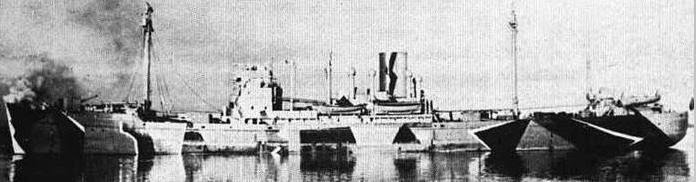 |
| © John Asmussen 2000 - 2009. Jonathan Ryan, Ireland Creator of the Hilfskreuzer section, |
Having laid up in Sylt, he finally sailed on February 7 with an escort of minesweepers, one of which hit a mine off Rotterdam and had to withdraw.
Moving through very shallow waters, the Togo ran aground twice on sandbanks off Dunquerque on February 8. On the first occasion she managed to extricate herself fairly rapidly by running her engines full speed astern, but on the second occasion she remained stranded off the port in full view throughout the daylight hours, waiting for the next high tide.
Four heavy flak batteries were brought to the shore, 300 metres from where she lay, in anticipation of an air attack, which never materialised.
When she finally floated off the following night, February 9, there was no longer sufficient darkness to attempt the Straits of Dover unseen, and so a bitterly frustrated Thienemann was left with no other option but to take refuge in the exposed and highly dangerous port.
The following night, February 10, she left Dunquerque unscathed with an escort of twelve minesweepers, and had reached Gravelines on her way to Calais when she came under highly accurate fire from the heavy coastal batteries above Dover.
Steaming at full speed for over forty minutes through thirty-three salvoes, while returning fire with her own heavy guns, she remained unharmed, until spotted by RAF Whirlwind fighter-bombers which scored one hit, causing heavy damage, forcing Thienemann, with one dead and three wounded, to put into Boulogne at a reduced speed of six knots to assess the damage.
As a result, five Hunt-class destroyers and six Motor Torpedo Boats that had been sent to intercept her,but failed to locate her.
Finding that it would take up to four months to repair, an impossible task given the security situation in occupied France , he had no choice but to turn back.
Remaining in harbour for the next two days, she was the target for an attack by fifty-six British aircraft on the February 12, but did not suffer any further damage, but following a visit by the RAF and the US Eighth Air Force on the February 13, she left Boulogne and headed back towards Dunquerque.
Once again coming under heavy fire from the coastal batteries at Dover, she survived twenty-three salvoes unscathed, reaching Dunquerque on the morning of February 14.
Next morning, as it was clear that a safe passage through the Channel was no longer possible, Thienemann received orders from the SKL, now under the command of Dönitz, to return to the Baltic, but was attacked yet again before he could depart.
The eighteen bombers involved scored no hits on the raider, but severely damaged the lock gates of the port, so that it was impossible for her to leave.
With the gates finally repaired on February 26, a thick fog prevented her from putting to sea, but did not prevent RAF Hudson bombers from mounting yet another attack on her, with one bomb passing clean through the after part of the ship without exploding, but bursting in the water under her stern, killing three men, wounding three more and causing serious flooding.
Despite this setback she was able to sail the next day, when once again she twice ran aground on the sandbanks outside the port, fortunately getting off under her own power on both occasions.
Although further attacked by eight British MTBs and MGBs which were successfully driven off by her escort, she arrived safely back in Cuxhaven on February 28.
As the captains of German raiders usually named their ships after they’d got out to sea, the Togo would have become the Hilfskreuzer Coronel had she succeeded in making it through the Channel.
Temporarily employed as a Blockade-Runner in 1943, she was subsequently converted into a Radar and Night Fighter Direction ship, under Korvettenkapitän Rudolf Lueck.
She retained her old name Togo until the end of the war, helping in the evacuation of beleaguered German troops from Poland and East Prussia, being bombed several times while doing so.
Seized as a prize by the British in August 1945, she was allocated to the US Navy in 1946, and used to repatriate Polish prisoners of war.
Sold to the Norwegian government as a fleet auxiliary in 1947 and renamed Svalbard, she was used by the Norwegian Navy to transport occupation troops to Germany.
 |
| Courtesy of the Bergenhus Fortress Museum |
As the Togo yet again, and handsomely refurbished, she returned to the Africa run for a further twelve years, after which she was sold to Taboga Enterprises Inc. of Panama.
Renamed Lacasielle in 1968, she was, amazingly, still in tramp service in the early 1970s.
Renamed Topeka in 1976, she ended her days aground off the coast of Mexico on November 21 1984.
Thanks go to © John Asmussen 2000 - 2009.and Jonathan Ryan, Ireland, Creator of the Hilfskreuzer section for the above article.
 |
| Courtesy of Wrecksite Eu. |
Jim;
On checking my log book I see that F/O Eddie Musgrave, Australian pilot on 137 Sqd found this ship and bombed it. I was unable to locate it as my note states that the ceiling was 10/10 at 3000 ft. and very black.
Best Regards,
John
F/O Eddie Musgrave was flying P7114 at the time of the attack.
Extract from the Squadron log book of S/Ldr Humphrey St John Coghlan DFC.
kindly sent to us by his son Mike Coghlan.
kindly sent to us by his son Mike Coghlan.

 |
| Edward Lancelot Musgrave DFC |
 | |||
| Pihen-les-Guines, Pas De Calais. |
Eddie Musgrave had a number of close calls while flying Whirlwinds. He was awarded the DFC after his attack on the TOJO. he failed to return from a night attack while flying P7063 and is buried in Pihen-les-Guines War Cemetery.
Pictures courtesy of Rob Bowater.
Whirly Stories

P6984
Joined 263 Squadron on the 22nd of December 1940 and was lost on the 19th of January 1941 when she was abandoned by Tom Pugh DFC near Middlemoor Devon.
Operational hours 19:00
Further information has come to light following Patrices inquiries into Whirlwind crashes in France.
1- P7001
(P.O. Masson, 10/09/41) went down near Lestre. That's in the
records/books. What was new to me is the fact that 3 photos were found (I
haven't seen them) about 25 years ago about P7001. It appears that PO
Masson managed to control the aircraft and crash landed at the edge of the
surf. The aircraft didn't explode nor caught fire. It broke in segments (no
further details about that, unfortunately). It also appears that PO
Masson died setting the aircraft on the beach - or expired shortly
thereafter. In any event, P7001 rested at the edge of the sea and was
under water at high tide later on that day. The Germans brought in their
heavy equipment and managed to remove the remains of P7001 from the beach/sea
and transported it away. Specifics and timeline about the salvage operation
remains TBD. Where the wreck was taken to also remains a (very interesting)
mystery.
Two
points here. One. A team of amateur archaeologists, including my contact
for that aircraft in France, searched the beach for parts about 25 years
ago. They knew exactly where to look for it. They found small
pieces of twisted metal but nothing of substance or that could be connected
with certainty to P7001. It means the Germans and the sea did a pretty
good cleaning job of what was left of P7001. The small bits of metal the French
found were discarded and/or lost over time. Bottom line, nothing is left of
P7001 on the site. Two: The crash landing of P7001 towards the end
of 1941, as reported to me, fits perfectly with the fact that the Germans'
"documented & printed" knowledge of the WW increased thereafter.
I have therefore concluded that P7001 is most likely the first WW that the
Germans put their hands on. Searches for German recorded drawings or
photos will therefore have to start from that point.
2- P7090
(P.O. Harvey, 18/04/43) down in Normandie. My contact for P7001 has a
theory on where the aircraft might have crashed. He believes P7090
crashed south of the Normandie D-Day beaches. He doesn't deal with that
region, so this is just a supposition at this time. He doesn't believe
P7090 has been searched extensively so far. He has initiated contacts with
peoples he knows in that region following our conversation. That might
lead to information about P7117 as well. P7117 was also lost on that
night.
3- P7043
(PO Gill, 07/11/42). My contact for P7001 and I fully agree on where
exactly the aircraft crashed. He has the advantage of having searched the
site about 20 years ago....It would have been helpful to have known him 18
months ago and me not spending time on this crash site search....anyway win
some and lose some as they say. We both agree that the aircraft was
cleared by a "Bergungskomando", the Luftwaffe' scrap/salvage team,
within a few days of the crash based on what we both know. He spoke to a
witness and that was confirmed when he did his original search. The
Germans also did a pretty good job at cleaning the site. My P7001 contact
only found one 20 mm shell and a bit of metal coming from a gauge. He has
those bits but is not ready to part with those. That's all he
found. The area around the crash site is now paved and a house sits on
the exact location where P7043 came to rest. We'll have to eliminate that
wreck from the potential lot.
4- P7113
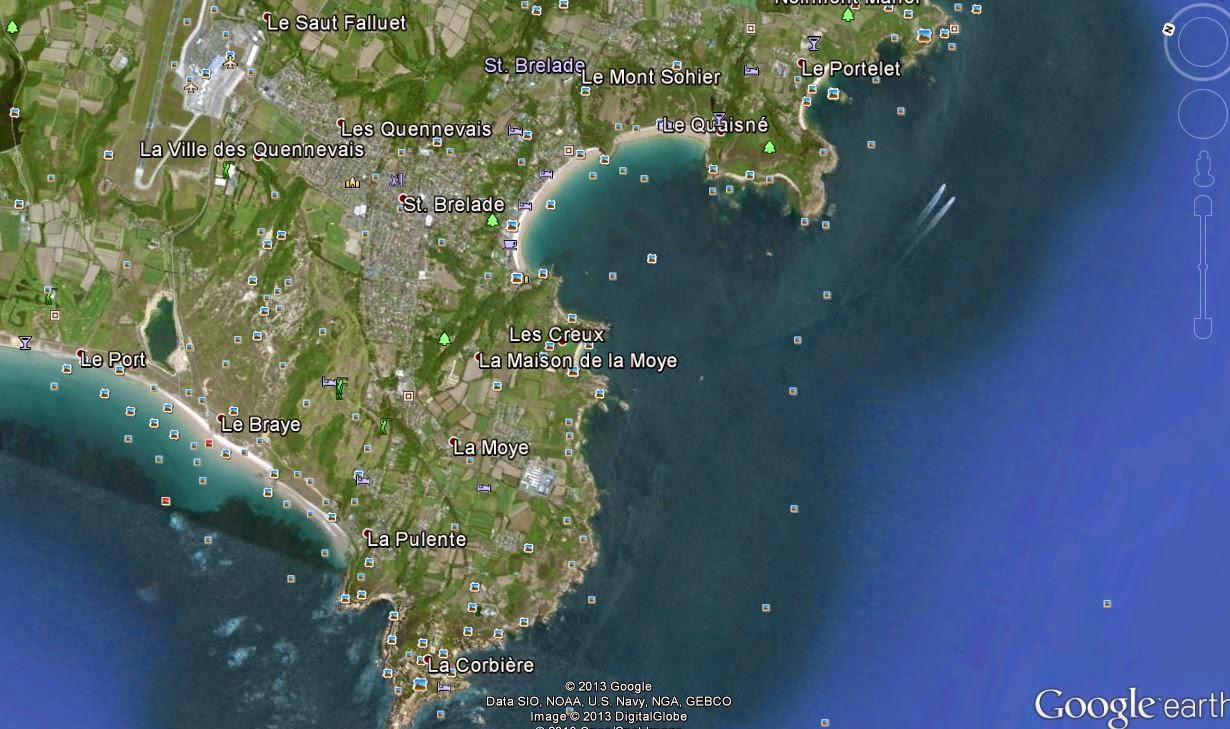
(FO G. Wood, 23/09/43). That is Rev'd George Wood's WW. Some of you
may recall that I visited the site earlier this Summer. Jim, I understand
you went there as well with Rev. Wood a few years back. I have a verbal
from the airport management [but that would very very likely need to be
escalated to the Municipality, the French CAA - among others I suspect -
and papered with all sorts of official documents] that they would agree
if someone would come with a metal detector and search the ground around the
.... runway. Beside the officialdom issue I explained above, it is likely
that P7113 didn't explode over the runway or even the airport ground. To
complexify things a little more, the Morlaix airport was straffed and bombed a
number of times between 1940 to 1944 (plus accidental German crashes).
The result, as you can expect, is a potential for all kind of debris,
everywhere. The land where I suspect P7117 exploded are either built up
or private light industrial. Not the easiest of spots to search and again
assuming nothing else crashed/exploded there (no guarantees about that questions about their search location / methodology and access to
that piece if we need to know more about it. Mr. Messager would be ready
to take it to Paris for me to check it out next time I am in Paris. Nevertheless, a team from the Carantec museum did some metal
detector work not long ago - specifically searching for bits of P7113 - and
came out with nothing. However, I learned in the process that the
Carantec museum was given a piece of "P7113" by the Reverend
himself. That was news to me. I need to get back to my
contact at the museum and ask
him further questions likewise, I need to speak to Rev'd Wood and ask him about the origin of that
piece he gave to the Museum. I am curious to know how a piece of P7113
made its way back to England & that might bring a few
interesting leads and stories.
If (2) is
Harvey's P7090, he is still listed as MIA, so may be problematic
excavating. The Sqn ORB thought he was shot down by an armed trawler off
Ouistreham, so it would put him in the same area. Could it be Cecil
King's P7117? He went missing on the same night, possibly near Airel
which is not far away from the Beaches area.
Has
anyone looked into P7015. She crashed at Kerdiny following an attack in
Morlaix. F/O David Stein's body was seen in the wreckage but he has no
known grave. Possibly something to do with his name being Jewish?
I would like to take this opportunity to thank Rob Bowater for the use of pictures and information from his book 'The Whirlwind Years' This book is available from Rob direct at ..
Contact details chris-hayward@outlook.com
Copyright Whirlwind Fighter Project 20011/2015
I would like to take this opportunity to thank Rob Bowater for the use of pictures and information from his book 'The Whirlwind Years' This book is available from Rob direct at ..
rob.bowater@virginmedia.com
Contact details chris-hayward@outlook.com
Copyright Whirlwind Fighter Project 20011/2015




.jpg)


